What did the Brontës write?
The Brontë sisters, daughters of a country clergyman, grew up to produce some of the most powerful and dramatic novels in the English language.
When Wuthering Heights by Emily Brontë was published in 1848, one reviewer wrote:
"... the reader is shocked, disgusted, almost sickened by details of cruelty, inhumanity, and the most diabolical hate and vengeance, and anon come passages of powerful testimony to the supreme power of love—even over demons in the human form."
It was one of the most astonishing reviews in English literary history. Nothing like it had ever been published before and nothing has since.
Now, the much-loved and world-famous novels grip the imagination of readers, inspiring artwork, music, TV, film and theatre globally.
Why have they had such an impact?
Between them, Charlotte, Emily, and Anne Brontë wrote seven books, including Jane Eyre, Wuthering Heights, and The Tenant of Wildfell Hall, respectively. They penned their novels here in the Parsonage - now the Brontë Parsonage Museum.
At the time, the sisters' writings were noted for their directness and emotional power - 19th-century critics called them 'coarse' and 'brutal'. Gripping plots, enduring characters, and passionate prose ensured the Brontës' novels would stand the test of time.
Dive into the worlds of the Brontë novels below.
Wuthering Heights by Emily Brontë
Emily Brontë's passionate tale of two families evokes the turbulent Yorkshire moorland around Haworth. Its nightmarish, Gothic elements and infamous protagonists, Cathy and Heathcliff, have helped it remain a genre-defining classic.
Charlotte Brontë's best-known work tells the story of Jane Eyre - a spirited, practical young woman who discovers a secret in the home of her employer, Mr Rochester. Moral dilemmas, supernatural scenes, and evocative landscapes characterise the first novel Charlotte had published.
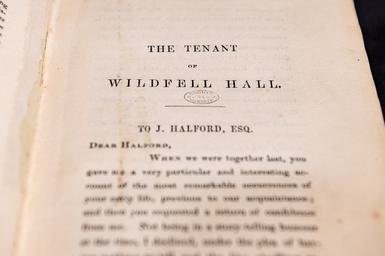
In 'The Tenant of Wildfell Hall', Anne Brontë lays bare the realities of drunkenness and abuse, recounting her heroine's attempts to escape from a corrupt husband. Set firmly against the protagonist's moralising tone, 'The Tenant of Wildfell Hall' bravely addresses a dark underside to the privileged society of the time, exploring women's agency within it.
In Charlotte Brontë’s last novel published in her lifetime, follow Lucy Snowe as she navigates her new life in Villette, largely inspired by Charlotte’s own time in Brussels. Expect autobiographical anecdotes, descriptive scenes, and the hints at the supernatural for which the author is famous.
Anne's first novel reveals the truth of what it was like working as a governess in Victorian England. Influenced by her own experiences, Anne tells the story of Agnes - the youngest daughter of a clergyman, who sets off to prove she can make a life for herself. By exposing the reality of work for the 19th-century middle-class woman, 'Agnes Grey' is Anne’s first endeavour at championing women’s rights.
Charlotte’s second published novel was a perceptive exploration of the industrialising Yorkshire she observed around her. Though set in the Luddite era, many of her characters were inspired by people she knew in her own time, including her sister Emily and best friend Mary Taylor. It provides a powerful analysis of women’s experience in a changing Britain.
'The Professor' was Charlotte Brontë's first novel, but wasn't published until 1857, after Charlotte's death. The story centres around William Crimsworth, following his unplanned departure from Yorkshire over the Channel to Belgium... Many have suggested that Charlotte drew from her own experience teaching in Brussels when writing the novel.